 schoolconnection77@gmail.com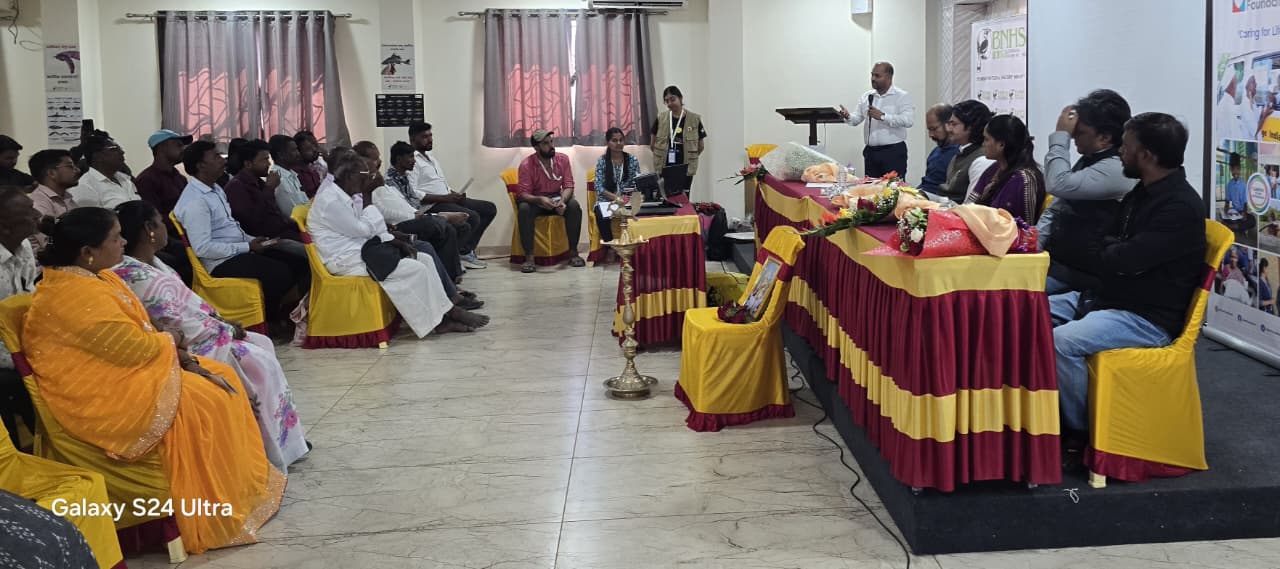
Time is Running Out: Expert Calls for Coordinated Action to Save Ujani’s Biodiversity
A serious warning has been issued by Dr. Unmesh Katwate, Senior Scientist at the Bombay Natural History Society (BNHS): “Save Ujani before it becomes ‘Bharatpur,’ otherwise tragedy is inevitable.” He also highlighted that a large number of native fish species found in the Ujani reservoir and Bhima River, including Khadra, Koyra, Nakta, and Tambera, have either been destroyed or become rare.
Dr. Katwate shared this crucial information at a workshop organized by BNHS in Bhigwan to discuss Ujani reservoir’s biological wealth. He explained that large fish and birds depend on small fish. The diet of various bird species consists of native small fish, but they are now forced to eat the invasive Tilapia (Chilapi) fish.
He stated that the increasing pollution in Ujani, coupled with the presence of species harmful to humans and the environment like the Sucker (Stonelicker/Armored Catfish) and Magur (Clarias Catfish), poses a significant threat to the fisheries wealth. This was revealed by an intensive study conducted by the BNHS over the last four months.
Need for Wide-Ranging Action
The Bombay Natural History Society will now bring native fish species from the Ganga, Warna, Koyna, Krishna, and their tributaries and release them into Ujani. These native species will also be bred. Khadra fish seeds will be sourced from the Tata company and introduced into Ujani.
Dr. Katwate drew a parallel with the Bharatpur Bird Sanctuary (Keoladeo National Park), a UNESCO World Heritage Site in Rajasthan, where the situation has become dire with the disappearance of birds and fish, devastating the local economy. The Magur fish has taken over, and government efforts to destroy them have proven insufficient. Dr. Katwate cautioned that Ujani is heading in the same direction.
He stressed that if this threat is recognized in time and cooperation is extended by local fishermen, fisheries businesses, water resources, and revenue departments, Ujani can regain its former glory, but this requires wide-ranging action.
Conservation of Native Fish is Everyone’s Responsibility
Dr. Katwate emphasized that large fish can only survive if small fish survive. The wealth of birdlife also depends on native small fish. Therefore, the responsibility for conserving small and native fish lies with everyone.
Species of small fish like Phenk, Aamli, Chachi, Bhati, and Tebki have declined. Native fish in Ujani such as Sengal, Sumbar, Aher, Tambera, Khadra, Kolis, Ghogra, Shingi, Chalat, Vaam, and Shingta are facing a crisis.
The BNHS will work for the conservation of these rare and destroyed species over the next fifteen years. They will also focus on destroying the invasive Magur and Sucker (Dagdhi Masa) fish. Dr. Katwate mentioned that the Cipla Foundation will provide major support for this effort.
Emphasis on Ujani Water Conservation
Anurag Mishra, President of the Cipla Foundation, stated that the focus will be on water conservation in Ujani and the restoration of native fish and the small fish essential for migratory birds.
The event was attended by Amol Sarmandal (Site Head, Kurkumbh Cipla Company), Narendra Singh (Site HR Head), Archana Shinde (Assistant Commissioner of Fisheries Business), Bharat Mallav (Chief of Ujani Andolan), along with Deepali Gund, RPI District President Vikram Shelar, Anil Nagre, and Balbhim Bhoi, among others.

 TOWN CONNECT